Posted on — Leave a comment

CollaboratioNZ 2023-Part 2 Coming Together

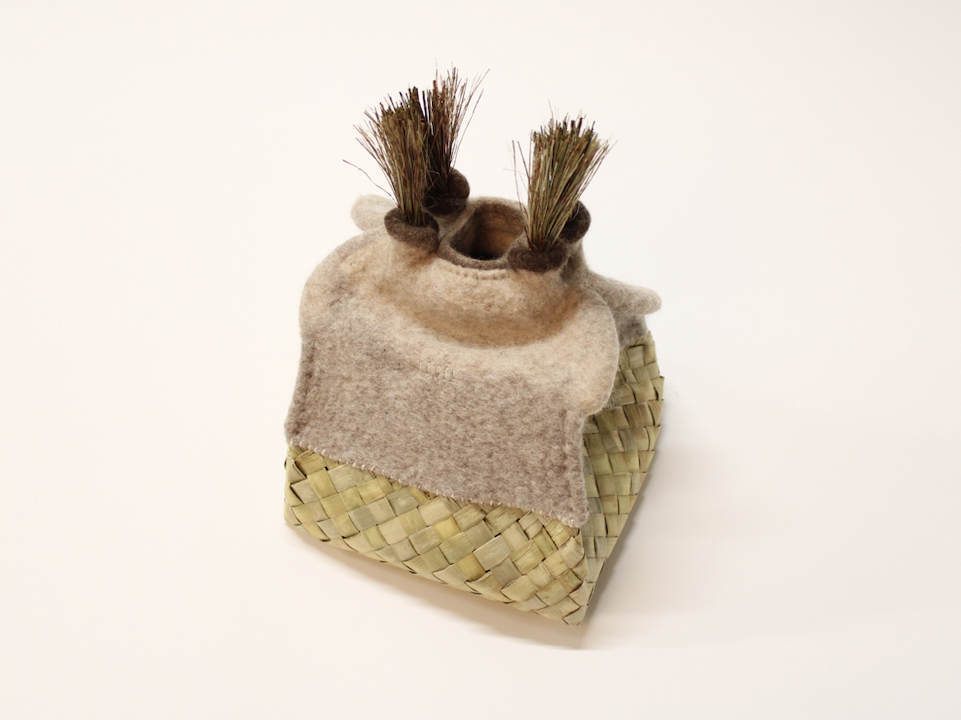
Woven basket with felt cover and brushes

I had in mind (and in my grant writing) to focus on making instead of teaching, connecting with artists working in different media from across the globe and to learn more about harakeke and Maori culture during my artist residency at CollaboratioNZ. I had first been introduced to harakeke in 2012 when I was invited to teach several felting workshops in New Zealand. I was gifted flowers by a number of participants made from split and woven leaves of this NZ flax plant that I still have in my house today. I quickly learned that it wasn’t the same flax plant, Linum usitatissimum, the stalks of which are processed into linen, but rather the leaves of the native Phormium tenax, or harakeke in the Maori language, that is processed. Just like varieties of wool, there are numerous cultivars of harakeke with different characteristics that are preferred for specific uses. 
CollaboratioNZ and North Carolina Arts Council logos
Woman holding large palm fronds at craft booth

Wendy Naeplfin, a current CollabNZ committee member and flax weaver seen here with a delivery of fresh harakeke leaves, gathered me into the passenger seat of her car (leftside!) from the bus stop in the town basin of Whanagerai and we wound our way out to the headlands. Upon arriving at the camp I met two more flax weavers, Raewyn Rouse and Elke Radewald. As I brought my studio items up to the fiber tent, I realized that these three would occupy the first two tables at the entry of the tent and occupied they definitely were! There was always a steady flow of artists seeking to collab with a harakeke weaver, a sheer sign of this plants cultural relevance and appeal to not only those of Maori heritage, but a broad swath of New Zealanders.

In my first INTRIGUE/BLOG post about CollabNZ, I described the making of the piece “Structural Change” sequentially from start to finish, simply because it was the first piece I started and certainly the most time involved. However, within a couple days I had 8 different pieces I was committed to working on and every one of them incorporated harakeke!

Elke is pictured here weaving strips of the harakeke leaf into a 2D plane while a line up of glass pieces await a fiber flourish or, in the case of that green bulbous vessel, to be nearly encased with a woven skin of harakeke leaves. I was fortunate to have my work station immediately next door and as I watched Elke develop hollow forms, I began to chat with her about the possibility of combining these seemingly disparate materials; hers being a coarser version of cellulostic bast fiber that needs to be processed into smaller elements to build forms and mine, thousands of individual wool filaments that need to be matted into a singular mass to sculpt hollow form. Felting would also be considered by many to be a more coarse version of wool textile compared to spinning and then weaving, knitting, crocheting, etc.

Hands weaving a palm-leaf mat

As mentioned above in regards to the naming of NZ flax, harakeke leaf is processed into fine strong fiber. Below, Raewyn uses a shell, a traditional method, to cut into and scrape away the flesh of the outer leaf, revealing the inner fiber, commonly referred to by the Maori word, muka. The quantity of processed muka on the table in front of Raewyn and I represents so much work in and of itself!  In the same photo on the left side, you can see on how the fibers are aligned at the top where Wendy has started to use a finger weft-twining technique (whatu) to bind the vertical warp fibers (whenu), which is the foundation of the amazing tradition of Maori cloak weaving. Honest, there were so many projects happening at this station, I can’t recall what Wendy was working toward with this piece!

Hands weaving a green palm leaf strip
Hands scraping green leaf with shell
Two women at weaving booth with fibers

Back in 2012, after I had finished my teaching obligations, I had rented a car to do a bit of exploring and visited the Whakarewarewa Thermal Village in Rotaroa. There, I saw my first piupiu, a skirt created by this process of removing sections of the outer flesh of the leaf in a strategic pattern that not only created a color contrast of leaf and fiber that could be accentuated by dyeing, but also a variation of texture and flexibility. As the sections of leaf dried they curled into a cylinder producing a distinct sound when they would rattle against one another as a result of the sway and flex of the muka fibers and the person wearing it. I was fascinated and given a length of this leaf and muka cording as a result of my diligent inquiry, but I hadn’t seen the process actually done until Raewyn began processing the leaves for a collaborative vision that all three weavers were working on.

Woven reed mat with black striped pattern
Handwoven straw bag with fur trim

On that trip, eleven years ago, I spent hours upon hours in the Maori Court of the Auckland Museum and had barely gotten through that collection by the end of the day when I realized I had no time for the remarkable work in the other Pacific Island galleries. Fast forward to this recent trip, where I prioritized revisiting the museum before heading north to CollabNZ. Some aspects/pieces were familiar while others seemed new or perhaps it was that I was looking with different eyes while studying the innovative applications and unique aesthetics of harakeke on display. Above left is a piupiu with fine parallel lines cut across the leaf so that this narrow exposure of muka fiber could accept the dark dye and on the right, a meticulous kete of softened muka fibers illustrating the mawhitiwhiti, cross-over technique, and embellished with feathers. Indeed, there had been a redressing or changing out of the textile cases since 2012 and I invite you to visit this link for the museum where the need to do this is explained beautifully and where you can also see an image of the main case where several of these pieces I photographed are currently housed. Needless to say, I barely got through the Maori Court again and luckily had another day to go back for the Pacific Lifeways and Masterpieces Galleries this time. A must visit if you ever find yourself in Auckland!

Close-up of diamond-patterned woven textile

On display in the Auckland Museum, as well as in the tremendous book, Whatu Kakahu/Maori Cloaks published by the Museum of New Zealand Te Papa Tongarewa, which I had brought home with me in 2012, I observed only a small amount of wool fiber in Maori textiles, specifically cloaks. As seen left in the Auckland Museum, pixelated points of colored wool are revealed in the taniko, the dense border designs of the otherwise flexible muka base (kaitaka), by using multiple colored wefts and varying the twist of the weft-twining. Wool was also used in paheke, the looping of yarn into the weft of the muka cloak base to create contrasting linear elements and also in pom poms/tassels, though many tassels were kuri hair, the now extinct Polynesian dog.

Carved wooden ceremonial staffs with woven fibers
Close-up of braided coarse beige fibers

The only sighting I made of anything resembling felt in the Auckland Museum were tassels on the Taiaha, a long staffed weapon with a carved spear resembling a head and jabbing tongue. These awe or dog hair tassels seemed far more likely to have formed into the matted tuffs on the dog though, rather than resulting from the intentional felting by a person.

I began to ponder Maori perspectives of the wool industry that came to Aotearoa with colonization and wools use, or lack there of, in Maori traditional as well as contemporary textile arts. I, an artist working primarily with wool, am interested in ideas of space, boundaries and intertwinement and find apt sociological metaphors in the felting of individual filaments or groups of filaments into a singular mass of felt. I thought perhaps the collabing of native harakeke leaves and wool felt could speak symbolically to colonization and reconciliation or, at the very least, the proximity and merging of different cultures.

Ruffled felted wool flower with central hole
Felted wool cat cave with round opening
Handmade felt birdhouse with straw base

Elke was game for a collab and we decided on a circumference for the midline of the vessel form. She built the base from harakeke early in the week and I was to develop what would be the shoulders and neck of the vessel. I have never woven flat strips of bast fiber into 3D form and had a lot of preconceived ideas as to how the harakeke rim of Elke’s form could integrate into small slits I intended to make around the belly of my felt form. Elke, I will take the liberty to say based on our conversations, was similarly unknowing of how my felting of a very large layout with what looked to be surface designs would become a postured form with armature-like protrusions using extreme differential shrinkage and directional fulling. 

So there I was, well into the evening of the last making day of Collab NZ 2023 when my felt for the top of the vessel had dried. Not knowing how to bring these two halves into one unified form as well as the metaphoric weight I had placed on the piece, I procrastinated, prioritizing other smaller projects with more confidence. Though overlapping the harakeke edge with the wool felt and the need for a third party (a needle and linen thread moderator) to bring together the two different materials/processes is less graceful, visually and metaphorically, then I had hoped for, Coming Together was “collab good.” We can keep trying over the distances that separate us, in fact, this is the best metaphor of all.

Posted on — Leave a comment

CollaboratioNZ 2023 -Part 1 Structural Change

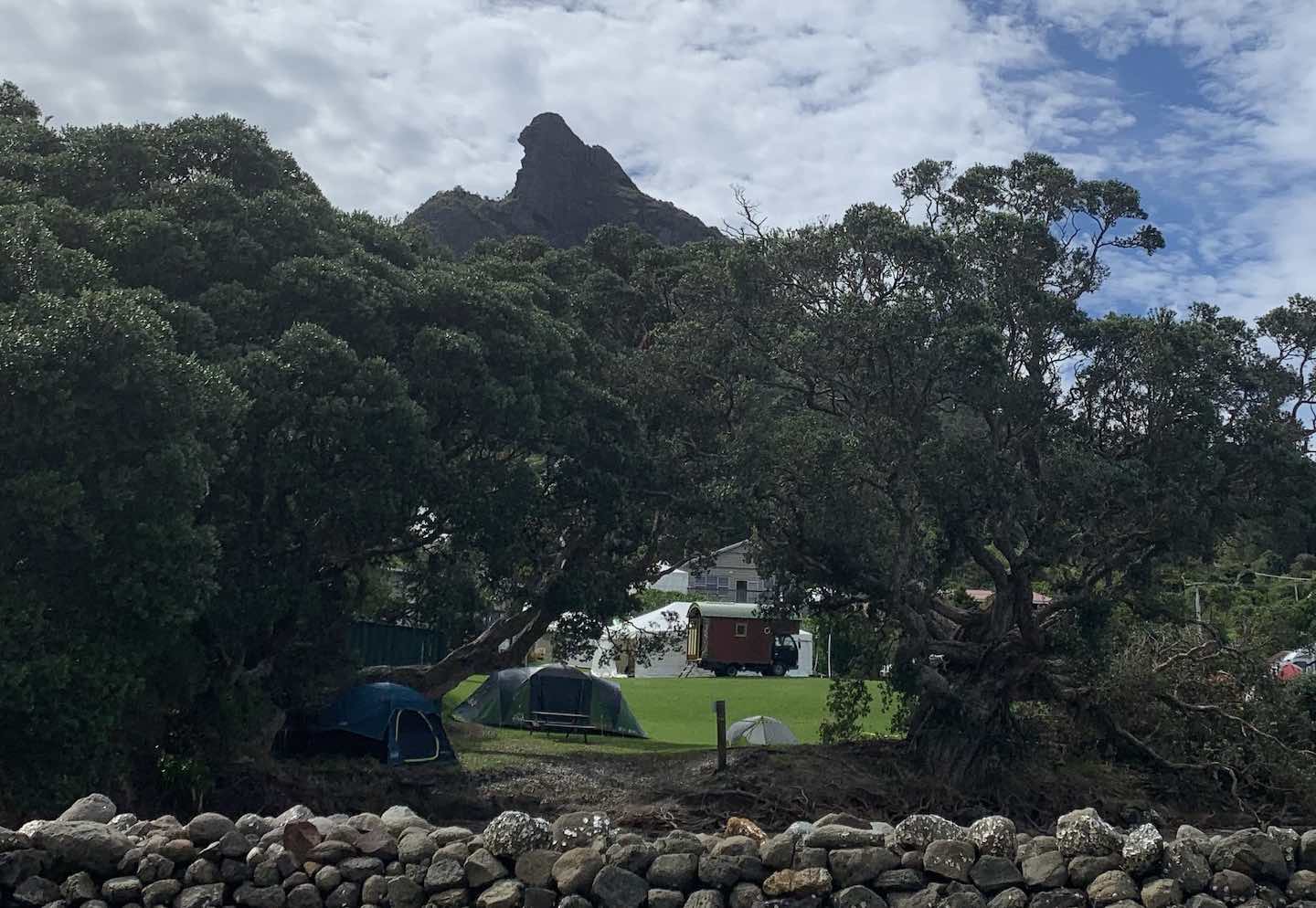
Tents at coastal campsite beneath mountain

I arrived at Whangarei Heads, the location of CollaboratioNZ,  a day before it officially began as I was keen to lend a hand, stake out my tent site, see what all goes into the set up and to meet the committee members I had been corresponding with for the past year.  Honest, I was also ready to get out of the hustle of Auckland’s city center and into the slower pulse of the remote Northland of New Zealand. Ha! So I thought! There were so many moving parts on the grounds and the electricity wasn’t even turned on yet! In just about 3 days, the Mt. Mania Baptist Camp was turned over into an adult art collaborative residency with a marquee for stone carving, ceramics, blacksmithing, fiber, glass, neon & 3D printing, mixed media, jewelry, print and wood working! Quite a feat on 3 different levels of terrain and yes, indeed, even a power hammer was brought to the site!

Vintage industrial metal press on wooden planks

Collab began the first evening, March 10 with a ceremonial opening based on the Maori powhiri. The Collab welcoming involved those who had been participants for many years receiving those of us who were new to the event in the communal hall where we greeted one another, shared our first meal (and all those to follow) and viewed images of one anothers’ work. I appreciated this sharing of cultural perspective led by the Maori participants for our particular setting. Thank you. 

Now the art making begins…

MANY WAYS TO COLLABORATE

One of the jobs I had during set-up or “mucking in” was to distribute resources from the main storage container to different media areas on the grounds. There was a cacophony of materials and found objects waiting to find harmony in the hands of makers. As someone who finds apt associations between my media of choice, felt (matted animal hair made into a skin-like substrate) and the human figure/experience, I picked up this barbie doll-like form and never put it down. The ridicule for the supposedly ideal proportions of the doll or the absurd, non-human color of the skin is nothing new. It was, however, the immobilization of the legs into a skirt, the alteration of the doll into a vessel and the placement of the opening to hold shampoo/soap (so I thought…it was actually full of talcum powder!), not to mention the headless or small featureless head that further perturbed. I had never seen one of these before and I decided to collab with this object to change the story by creating a new skin while also sharing with the Collab community the working of felt very thin into a hollow form that could be shrunk down over a form to reveal its contours, or in this case, structurally change them.

Pink plastic figurine on bubble wrap
Dark fabric figure silhouette with raised arms
Dark brown plush toy on bubble wrap

I set about with the mental and mathematical process of flattening the form into a 2D template that was enlarged to accomodate the amount of shrinkage I would achieve with the weight of wool I would envelope the template with. I had access to a beautiful natural color in a fine quick felting wool,  which is ideal when working this thin, thanks to the efforts and connections of Collab committee member Wendy Naeplfin. I made some thicker sheets of felt that I had partially felted to a specific density allowing for shapes cut from it to retain their shape, but to also have enough shrinkage remaining that they would incorporate into the thinner skin. I added denser partial felt shapes to the figure’s lower belly (as you can see in the middle image above), to her upper arms and to her behind. I opted not to give her droopier or lopsided breasts, as I wanted the barbie doll figure to still be recognizable. I rolled the felt in bubble wrap to start the fibers integration, cut a hole to remove the template, slid the plastic form inside and stiched up the cut. I then began the process of sculpting the new form by directional agitation of these different weights of wool until the skin was snug against the plastic, the denser shapes in the right locations to create this new form.

On a side note, I’ve made a number of figurative works with felt using a variety of methods including encasing a baby doll form in a wool & silk skin and using this differential shrinkage method to sculpt a face, but I had never modified the form of a pre-existing body in such a manner. In the past few delirious days of jetlag, I came across some posting by Jason Freeny of @gummifetus who is also exploring the alteration of barbie doll forms. Maybe check that out if this idea interests you!

Smiling vendor at craft booth with jewelry

PUBLIC OPEN DAY

Collab began on a Friday evening and I managed to make samples of the wool I had access to, to get this felted figure finished and layout another template for what would become the figure’s head before the Public Open Day on the following Tuesday. We had a constant flow of visitors come through to see what we were making and perhaps set their eyes on pieces for the auction the following Saturday. Above, you can see the figure in front of me, a large doll head and the even larger prepared layout in my tray at the end of the table that I would be felting  around that head during this 5 hour event.  Also on my table, there are a few pieces I brought from home as examples of my work and in particular, pieces from a body of work I had made inspired by my last visit to the Pacific Islands when I was a guest workshop teacher for the Hawaii Craftsmen in 2017. And lastly, but prominently, I also displayed the logo of the North Carolina Arts Council that had awarded me an Artist Support Grant which in addition to the support from the CollaboratioNZ Trust made this trip possible. Thank you.

Volunteer inspecting large brown organic specimen
Smiling woman crafting at community event

At this point in the Collab, having made connections with one another, seeing how others work and what materials they brought, the structure of this felted figure was about to change. Kath Batchelor, who works primarily with found objects, had quite the collection of doll parts and she offered up a big head of brains for the felted figure.  I also had a chat with sisters Amy Lynch & Katie Baptiste, who work with repurposed colorful 44 gallon steel drums in their creative buisness, METcALfe. I was drawn to the color of their metal work and thought it would be an interesting and surprising contrast to the natural wool colors. I was thinking the figure needed some sort of mount or base and as she had a strata volcano shape, wouldn’t it be appropriate that her base be made from a container that holds the earth’s fuel? They were game for making her some sort of metal base and suggested the head of the felt figure have a mohawk. Perfect! I had found a stash of just enough copper colored locks on the fiber resource table to make a good representation of a fiery lava flow from her head. 

A big thanks to fellow Collab artist Todd Sheridan who happened through the fiber tent at the ideal moment to document my inflation of the figure’s head in the images above. This helps loosen the felt from the surface of the resist to make it easier to pull it out of the small hole cut in the felt and well, it is also just fun to inflate things! Also, thanks to photographer Tania Whyte from the NZ Herald’s Northern Advocate who came by Collab for Public Open Day and captured 10 fab images of enthusiastic Collab artists rocking their blue shirts. Check out the article by following this link!

Abstract fabric head sculpture with wire skirt
Abstract twisted dark head sculpture with curly hair

Amy & Katie began working on the figure’s base the next day and their vision was one of a more knarled appearance than I had originally envisioned from looking at their work. There are many ways to collab. Some people will ask for a specific component to be made for a vision, while others will put forward and idea and see what the other artist(s) come up with. I did like the linear, fiber-like quality of this base made by bending, twisting and welding the repurposed steel rod. It reminded me of the fluid, yet hardened, pahoehoe lava flows I had seen on the Big Island of Hawai’i. I would also see in my post Collab exploring how its configuration represented the knarled volcanic rocks along some of Northlands coastline that the NZ sisters would know better than I.

I was aware of Pele, the Hawaiian volcanic deity and so asked Jo Tito, a Maori artist making paper with Harakeke flax in the Collab fiber tent, if there was a Maori deity and she spoke of Mahuika, whose fingers were flames. Another Harakeke artist, Wendy Naepflin had some muka fiber processed from the plant which had a naturally occuring redness. I used it to extend the felt figure’s fingers into a fan of flames, creating a regal collar of sorts as the hands supported the weight of her big brains. These fine muka fibers remind me of a phenomenon known as Pele’s hair where molten strands of volcanic glass are creating by the bursting of gas at the surface of a lava flow. I’ll share more about the Harakeke in the next blog posting.

Wire dress mannequin sculpture with head

I named the piece “Structural Change” and submitted it to auction with my name and the sisters, Amy Lynch & Katie Baptiste. In writing this blog post, I now realize that there were many others that contributed, not to mention other moments in time and place that influenced the work. That right there is the heart of Collab for me; the process of making as a means of exchanging and acknowledging just how intertwined we are.

It did, however, become obvious that I needed to take this figure home from the auction and that the base unfortunately wasn’t going to make the fit for my luggage. That metal base awaits in the resource container, from where I had pulled the barbie-doll, like a game of exquisite corpse to be responded to and repurposed at Collab NZ 2025. The exchange will continue as the goal of $70,000, the seed money for the next event, was achieved!