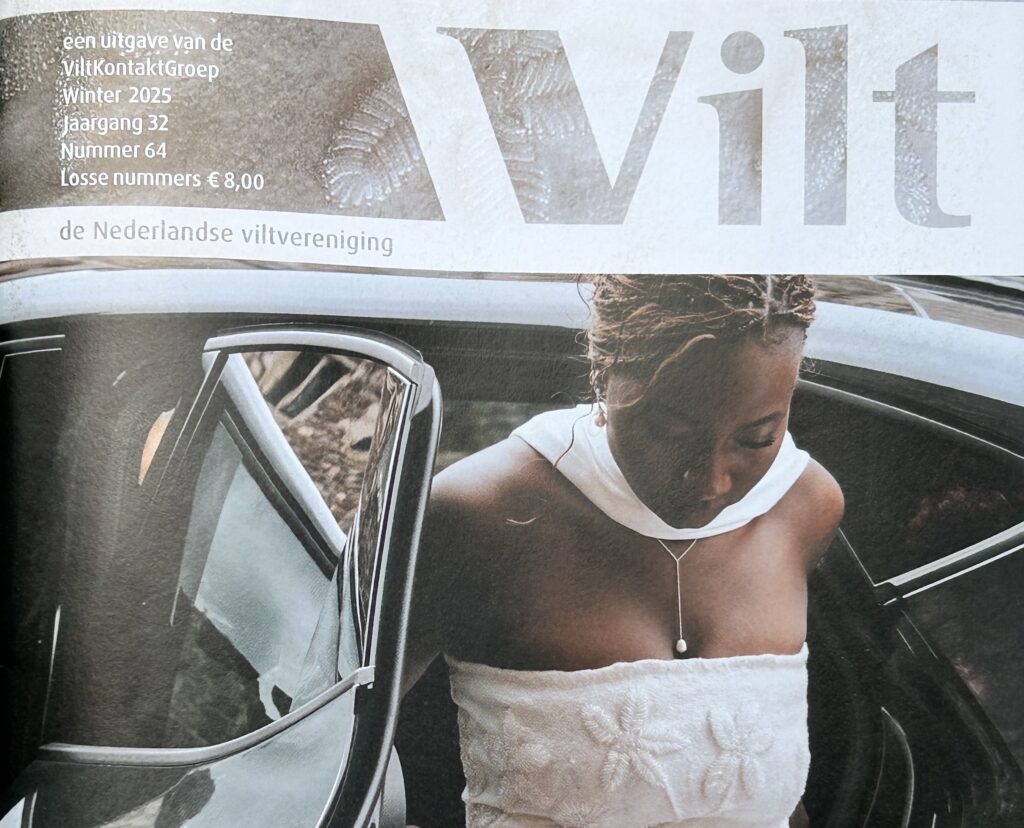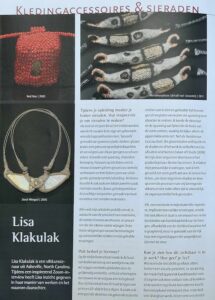
I was asked for an interview for the Winter 2025 issue of Vilt, a magazine by Viltkontatgroep, a Dutch felting organization. Nelleke van Andel presented many thoughtful questions and in return, I spent considerable time contemplating my answers and noting relational examples of my work. In agreement with the magazine, I am publishing the full four page interview in English on my website blog, INTRIGUE. The red text and most images are links. Enjoy!
What inspired you to make jewelry?
As an 80’s kid from the mid-west USA, there was a craft craze of knotted friendship bracelets, lanyards made of woven plastic strips and glass seed beads patterned on safety pins and threaded together on shoe laces. I learned about tension, spacing and movement. Focusing on something small and building something new provided a sense of control, confidence and pride during years of challenging family dynamics/divorce. Wearing my creations was a badge like the embroidered patches signifying accomplishments on the sash of my Brownie and Girl Scout uniforms. As a teen, there was also a local jewelry store that I often visited with my mom and I was mesmerized by the chunky compositions made from wood and other nonmetal materials.
Explain/Translate this quote from your artist statement. “All encompassing of my artistic practice is an attention to the porosity of materials, the space within and between, and processes that modify that internal space. These micro-environments provoke memories of spatial relations in my lived experiences.”
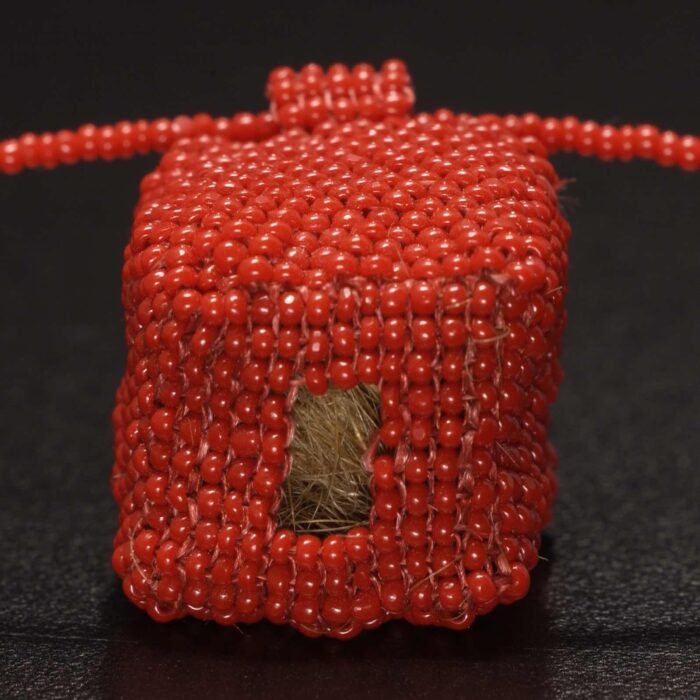
In high school, I learned basic bead weaving on a loom, that is pushing a string of glass beads through the evenly spaced, vertical warp threads and then threading a weft thread through the top of the bead holes to secure them in a 2D plane. I was also using gourd stitch to interlock beads in the round to create undulating tubes and using the addition and subtraction of beads to create tension around objects. I knew the mesh work and tension of lines that created the armature of the form, where the viewer sees only the surface form. Like the glass bead artist, Liza Lou smashing the glass beads to reveal the threads and the labour in Classification and Nomenclature of Clouds (2018), it is these unseen structures in the making process that fascinate me. I relate my personal experiences, what I have felt that gives shape to who I am and how I am, to these unseen threads and these tensioning processes of free-motion stitching and wet felting that I eventually found as a means of expression.
“Felt, a constant in my material repertoire, implicates human experiences, as it is not only able to visually convey a range of states of vulnerability depending on the density to which it has been agitated, but is made of animal hair with attributes similar to our own.” Can you tell how this is visible in your work? How you teach?
Wool fibers that have not been densely fulled have a visual porosity, a fluffiness that makes the surface more vulnerable to abrasion and also more apt to stretch and be imprinted by external impact, an interesting idea conceptually, but not for wearable work. I am an advocate for fulled felt, STRONGFELT. Particularly, thin felt with a high percentage of shrinkage is similar to a second skin and worn over crucial and sensitive body parts like wrists, the heart, ears, feels protective. Animal hair regulates temperature, offers protection from the elements and is intertwined with the nervous system to react defensively to threat.
Did you know that piloerection, better known as goose bumps, is caused by muscles at the base of hair follicles contracting? Felt is borrowed hair for increasingly hairless humans. I did a series in 2016 titled, Hair is Adornment, exploring the idea of hair volume and density inspired by coming across several sets of rollers and their hair pins at a second hand store.
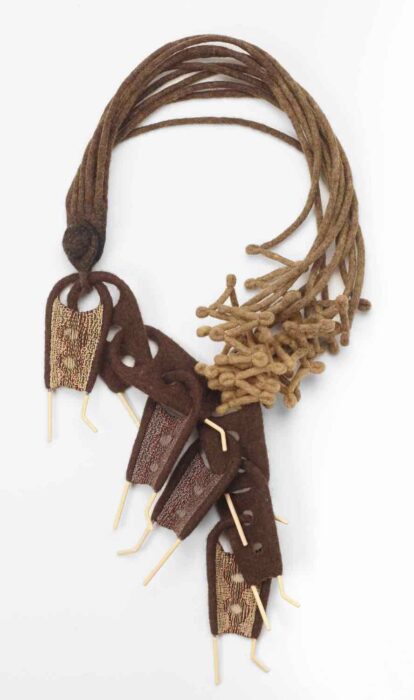
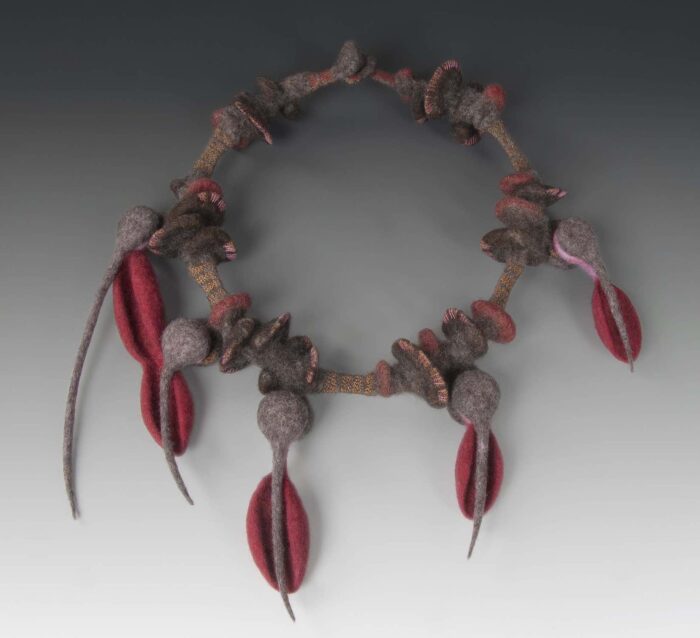
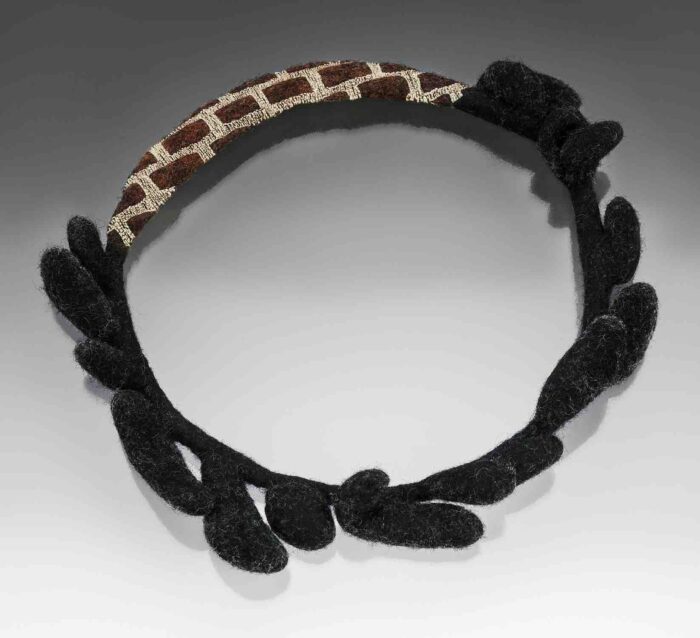
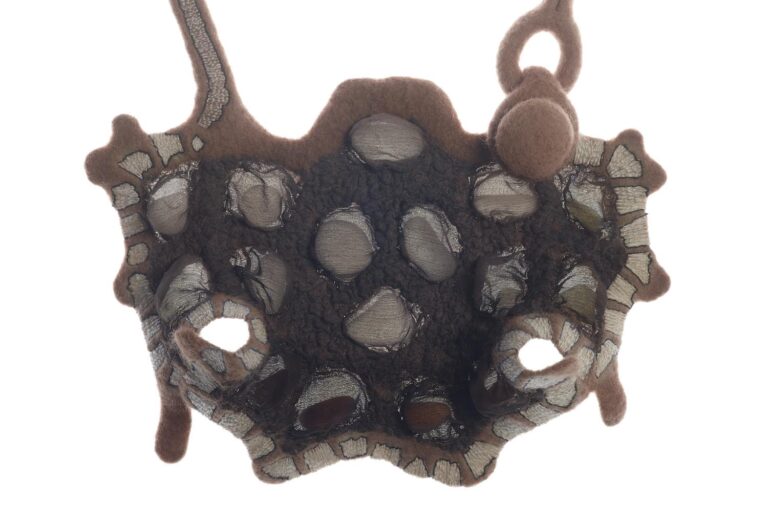
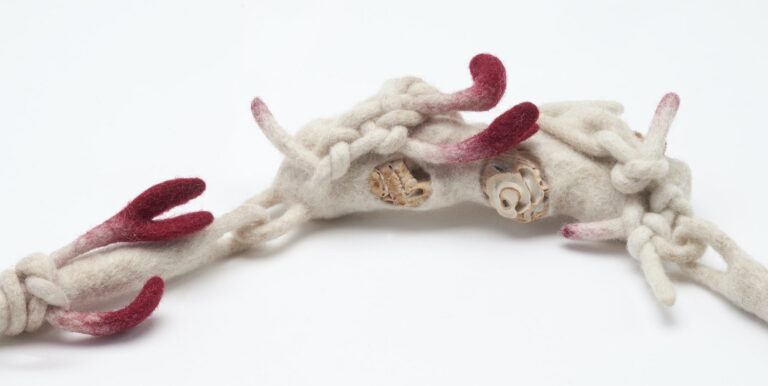
These ideas of vulnerability are conveyed in my jewelry by reference to objects and phenomenon, but also using the elements and principles of design. For example: the tough pod of the Banksia seed cone; the brick wall on the backside of a necklace in contrast to the protruding forms reaching out; the flex of the soft tissue tendons that connect in contrast to the rigid taut bone; the density of a stone wall versus the translucency of letting the light in.
You reference “felting on faith” when you work thin. What is the benefit of using thin layers?
Working thin allows one to SEE and know the space between fibers that decreases with agitation. I think primarily about space when I design, layout and felt. “Felting on Faith” is a comment I’d throw around when teaching because when you know there are fibers there touching, despite being laid out soooo very thin it is hard to see them, you trust the process and are in a flow with it. Thin, high shrinkage felt has incredible strength AND drape. With the inclusion of weighted objects it has a reptilian or vertebrae like movement. In combination with dense areas of low shrinkage partial felt it can be sculpted into the most amazing of forms, a process I began teaching in 2009 as Extreme Differential Shrinkage.
During workshops you explain technique and don’t work toward an outcome/product. Why do you choose this method?
I teach the way I taught myself. The study of variables and extremes has provided the knowing in mind and touch that gives confidence to tackle any idea. A well designed tool belt of techniques to move the material is far more valuable in the long run then following step-by-step directives to make a certain thing in a certain time frame, particularly without considering the why for each step. Thinking takes time! The product of my workshops is learning, the journey not the thing or its use. When I teach for longer durations such as at Penland School of Craft, college semester courses or in my 10 week Online & Onpoint! courses, I am able to teach technique and support participants in designing their own unique project, but in a couple day course, nahhh.
Travelling is a source of inspiration. Do you go travelling for inspiration or is it the other way around, that you travel and get inspired by the things you see?
This is a bit of the which comes first the chicken or the egg. Travelling can be as simple, easy and cheap as “lingering longer and looking closer” in your immediate surrounds like finding hair roller pins at a thrift store, tightly bound worm casings on a beach, the agitation lines in the web of a Writing Spider at a neighbour’s cabin. There is seemingly endless inspiration in noticing what you notice and why, both in composition/aesthetic as well as your personal story/memory that brings objects and phenomena to attention. Of course, the farther you go from your routines and cultural norms the more dramatically different the observations become.
What is the relationship for you between vulnerability-security and felt?
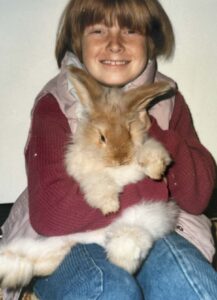
Early on in my working with wool yarn (this was learning to weave with attention to spacing both in warp/weft and difference in material shrinkage in 2002 at Penland School of Craft), I was encouraged by Janet Taylor to ask myself why I was attracted to making with a particular material and process. In addition to obvious associations of comfort through soft touch and warmth of clothing, I reminisced about caring for my Angora rabbit Haystack’s matted hair during particularly tumultuous years in my childhood. Soon after, I came across an incredible article Wool: Fabric of History, published in National Geographic 1988 with unforgettable images that brought to my attention traditional felt clothing, rugs and walls for housing and the idea of second and third skins of security for our increasingly hairless human bodies. I also researched material properties of felted wool, which offered conceptual fodder that I am still processing in my most current work: from fire suppression and moisture retention to sound proofing… felt cushions human experience.
You have stripped down felt to its basic principles. Like a natural philosopher, you have explored felt: its tension, compression, density, resistance, where it wants to go, where you can push it. Have you always been a philosopher in your work?
I have always been hyper-sensitive and I have come to overstand (word choice is intentional) that that is a very wonderful and powerful attribute. I have also always been occupied by making, transforming material into something new. Being physically impacted by and attentive to my surroundings, I process this awareness of external elements, visual as well as feelings of space, movement and sound through making. I suppose I have learned to think deeply about what I am doing. This is something I try to convey to those who study felting with me: it isn’t just doing, following, but thinking about what you are doing, being attentive to the dance between your character and that of the material, process and/or object.
Can you briefly outline the development in your working methods and use of materials?
From 2002-2005, I investigated process and variables during a 3-year artist residency (when I had some of the costs of living subsidized), which culminated in a body of work for exhibition that received press and awards. Then, I focused on making unique functional items that took less time and were more saleable at markets and in my classes. This work felt like a sketchbook of ideas for when I had longer stints of time at home to make sculpture. In 2012, with a demand for teaching and increasingly weary hands, I began teaching from my home studio, made less repetitive work to sell and then stopped doing markets in 2015. I began teaching online courses in 2020 which provides more time at home to make more involved/poignant exhibition work, gives those students more time with the content and the opportunity to develop unique projects and alleviates my hands from demonstrating the same things quite so much!
Lisa Klakulak gives in-depth training online called Online & Onpoint! The training courses focus on techniques of solid form, 2D and hollow forms. Course 1 begins Feb 22, 2026. www.strongfelt.com/online-coursework/
In 2026, Lisa teaches at Vrouw Wolle in Essen, Belgium. There are two trainings: Constructed Felt Vessels: Edge Welding Cylinders and Textured Panels, June 6-10 and Advanced Pendants: Elaborate Bails & Bezels, June 12-14. Link to the full 2026 STRONGFELT TEACHING SCHEDULE.