Posted on

Partial Felt from the Beginning

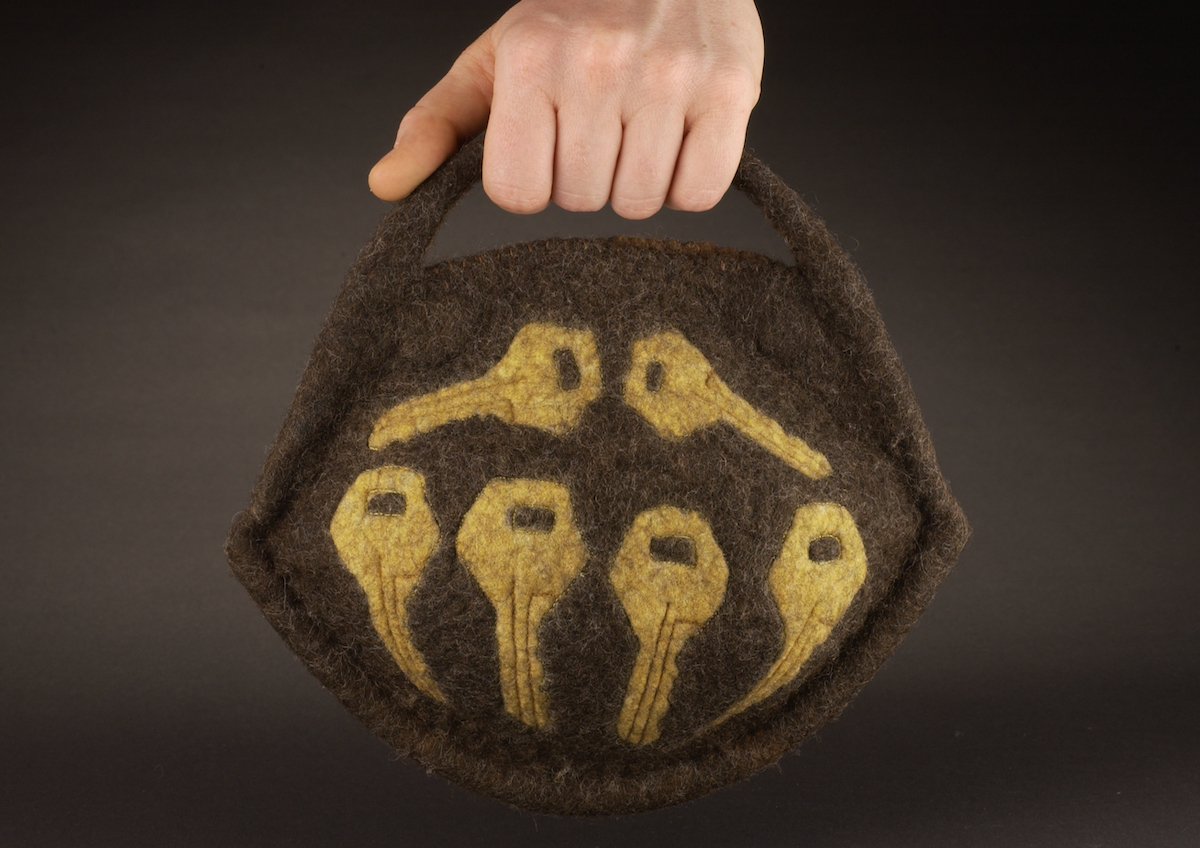
Hand holding round felt bag with key designs

I sat down the other morning before my eyes were fully open, but with the clarity of thought to write out the content description for Course 2, Applications of Partial Felt in my Felt Jewelry Series: Material, Technique & Impact.  You can have a read over on the Online & Onpoint! Coursework page under Course 2, where I define this term Partial Felt that I coined (vs the term Pre-felt) and describe the foundational ways I use it in my work from shaping solid forms to patterning surfaces and sculpting form. 

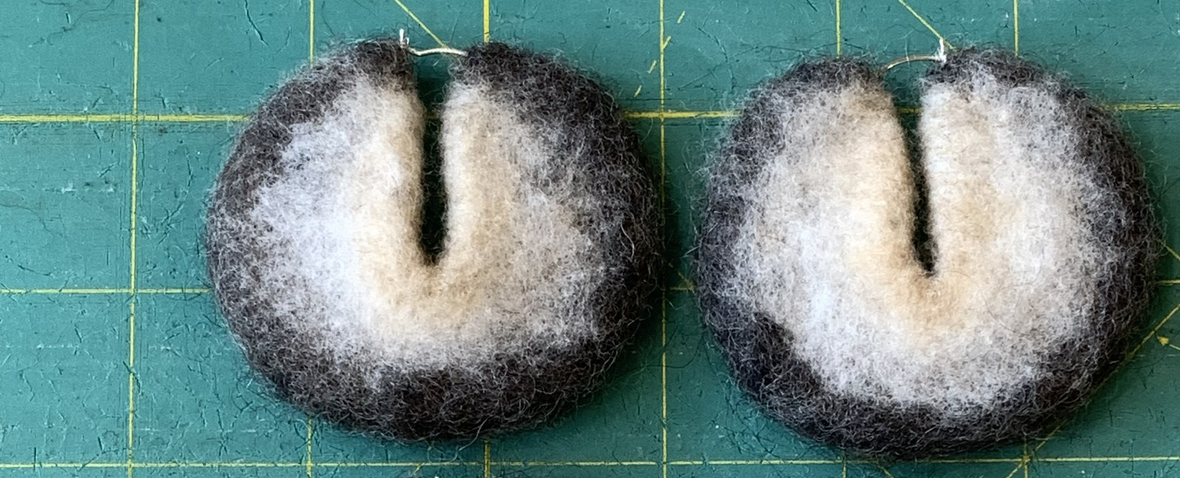
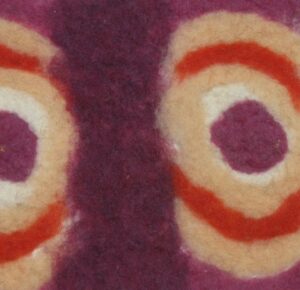
I was recently entertained by looking at some of the VERY FIRST attempts I made at patterning felt (making distinct color areas) back in the early 2000’s while a resident artist at the Appalachian Center for Craft in TN.  Here, I had laid fibers of different colors next to one another to create a felt that was the same front side and back. Indeed, the same irregularity of edges, holes and weak spots between colors on both sides because I was trying to keep the colors distinct rather than make a consistent and strong piece of felt! Ha! 

Felted wool with orange concentric circles
Historic Felt Strongfelt Lisa Klakulak

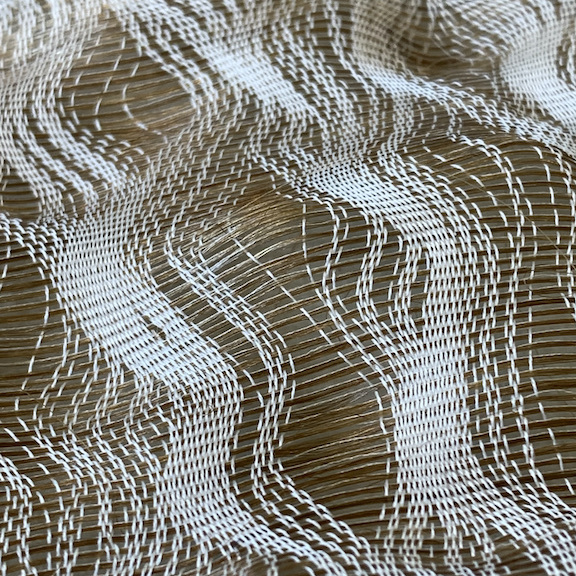
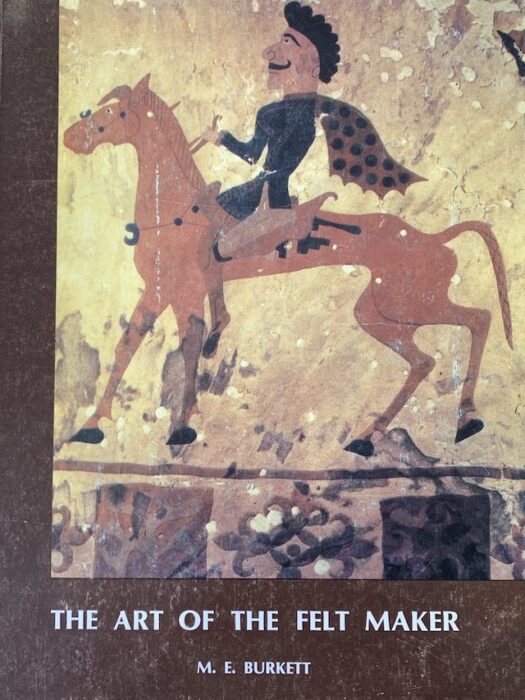
Then, I paid attention to the cover of “The Art of the Felt Maker,” a book I had been given by Janet Taylor who I was honoured to have assisted in a weaving concentration at Penland School of Crafts in 2002. Compiled by Mary Burkett and published by Abbot Hall Art Gallery in relation to an exhibition of the same name that travelled throughout the UK in 1979, the cover is a detail of a wall hanging from the Pazyrk Burial Mounds in the Altai Mountains that was unearthed among items dated from the 7th-2nd Century B.C. 

The only means I could think of to achieve such fine shapes/imagery over 2000 years ago would have been to partially felt fine sheets, cut and organize the shapes into images and then felt them into/onto a background of fiber. As natural dyes, of course, were only available at that time, I eventually experimented with felting sheets first and then dyeing them as a piece vs as fiber.  An example of this work is my Key Handbag from 2004 pictured at the end of this post. The concept of Partial Felt was and would continue to be key to my felting practice.


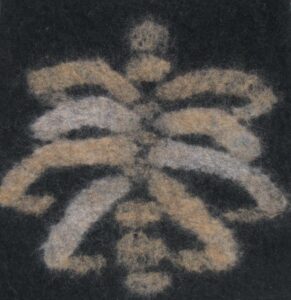
However, I first began felting sheets of commercially dyed wool and cutting them up to make shapes of various sizes based on a less than accurate means of knowing how integrated a piece of felt was. These ideas might seem familiar…use 7 layers of wool or roll 20 times or for 20 minutes and then cut. One person’s 7 layers will be thicker or thinner than another’s and one person’s roll will be stronger or more vigorous than another’s depending on whether they had a hardy breakfast or have arthritic hands, etc. My FIRST PARTIAL FELT shapes, likes this spider inspired design, would fall apart-disintegrating at the edges depending on the size I cut them and that wasn’t the only reason…

Wool felt ribcage motif on dark fabric

I’d argue that the human is the biggest variable in the felting process as the agitator and dictator of felting conditions! Ha! I found that tracking my felt by weight per specific area and at what point in the spectrum of shrinkage possible for that weight that I cut my shapes is the most reliable control to create desired outcomes, like edge definition. Felt is a relation of mass and space and with more space remaining in the felt the fiber lengths are not yet highly intertwined, so when cut into small sections, they simply aren’t bound to the mass and blur the cut edge.

Felted wool necklace with embroidered panel
Partial Felt as Core
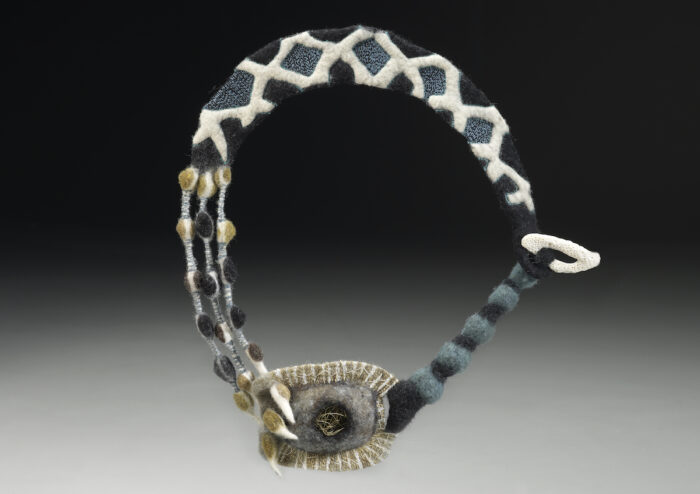
Felted fiber necklace with geometric pattern
Partial Felt as Surface Patterning
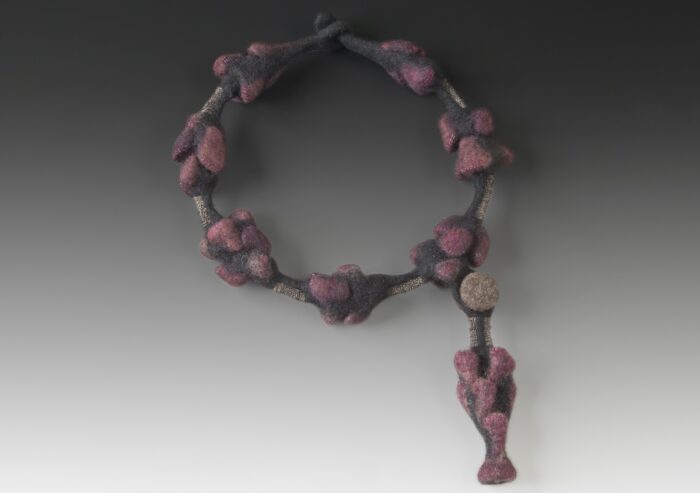
Handmade purple textured bead necklace on gray
Partial Felt as Protuberant Form

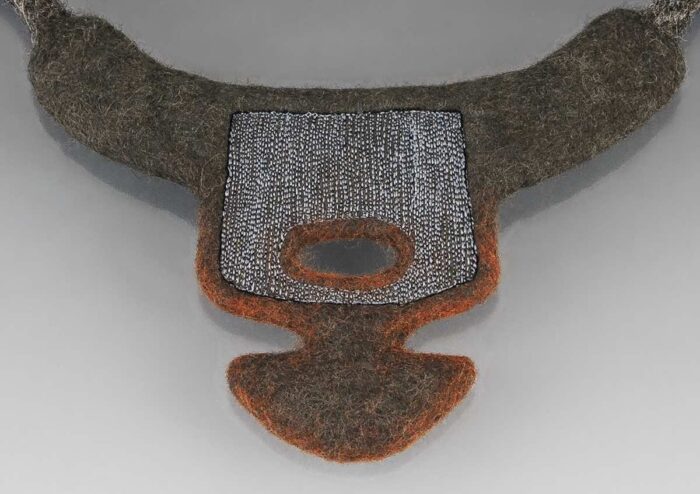
I also found with having this increased level of control so much more was possible with the application of Partial Felt than I had imagined when first inspired by the historic felt pictured on that cover. Above are examples from my work of the shaping, patterning and forming that will be covered in Course 2 in my Online & Onpoint Felt Jewelry Series. Disclaimer: Free-motion machine stitching won’t be covered in this course, but rather will be part of Course 3 with a focus on TEXTURE!

Posted on — Leave a comment

GRATITUDE FOR MY HANDS…KINKY PINKIES AND ALL

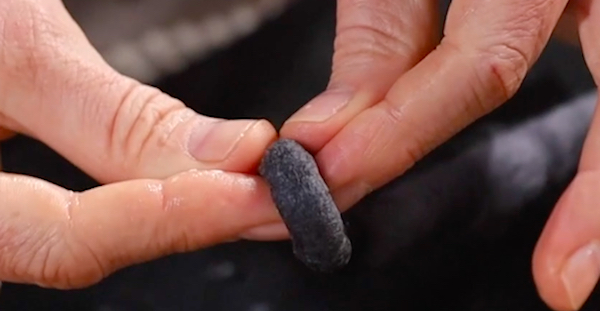
Hands shaping small dark cylindrical object

Greetings. Doing that intro thing for folks new to following this website and to share where I and STRONGFELT are at these days…autumn 2022.

I’m Lisa Klakulak and evidenced by my kinky pinky, I like to work with my hands…following in the tradition of the farming/gardening/project-doing side of my family (the kinky arthritic hands too). I have been sculpting wool fibers in the wet felting process and hand/machine stitching now for over twenty years and not as a side gig or a hobby, but a full-time hustle. Years of my making can be viewed in the WORKS galleries on this website.
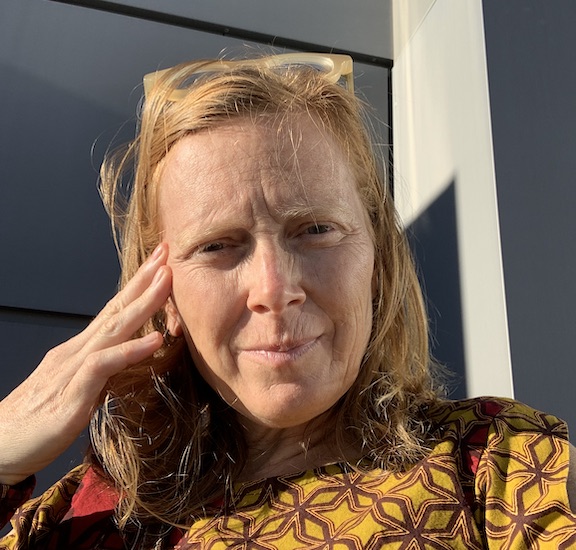
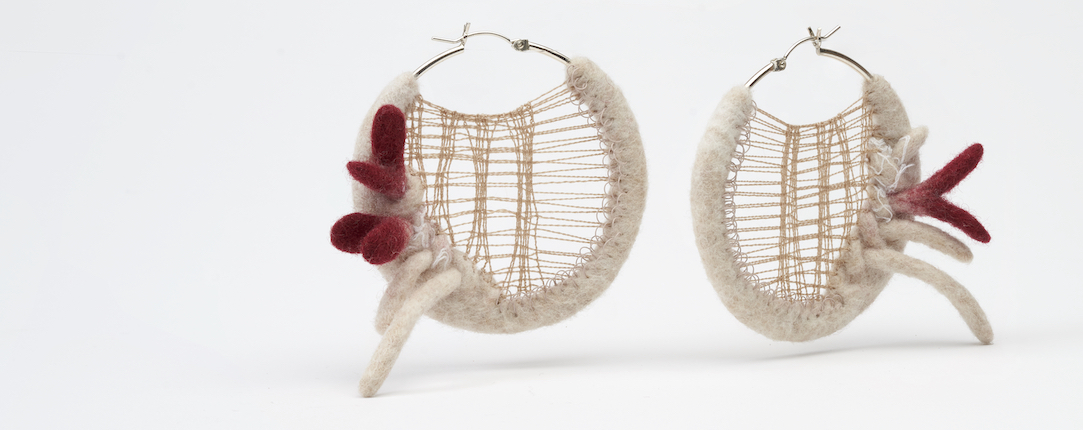
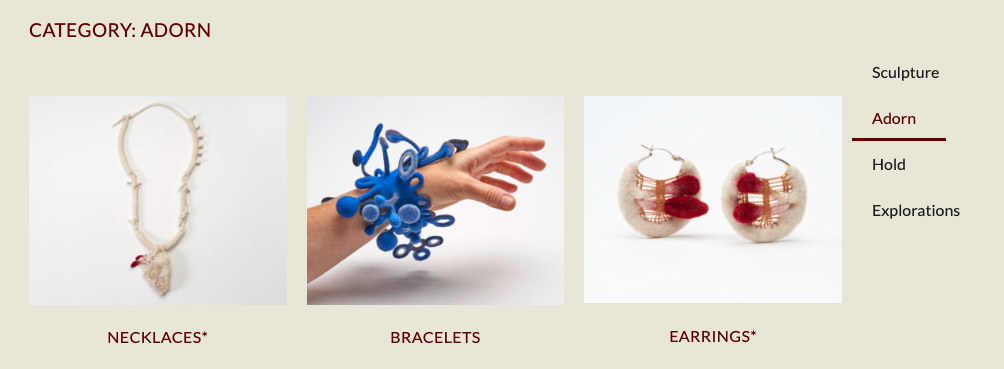
As time has passed, it became more and more apparent that, like the felting process, I was sculpting my own body via shrinkage and compression, through repetitive and directional agitation. I have focused more and more on teaching, finding joy in encouraging others making and the passing on of my approaches to material and process. I no longer do craft shows to spare my joints the agitation of production, as I want to use these hands for intentional projects and conceptual explorations and less for cranking out 20 bracelets, 20 sets of earrings, etc. You can view my most recent, small collection of WORKS from 2022 under ADORN:NECKLACES & EARRINGS.

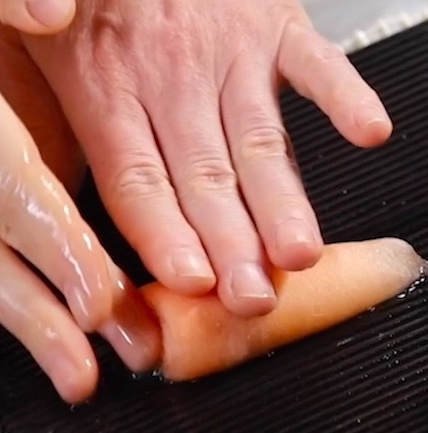
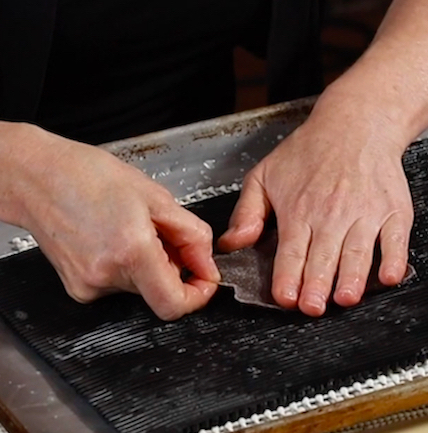
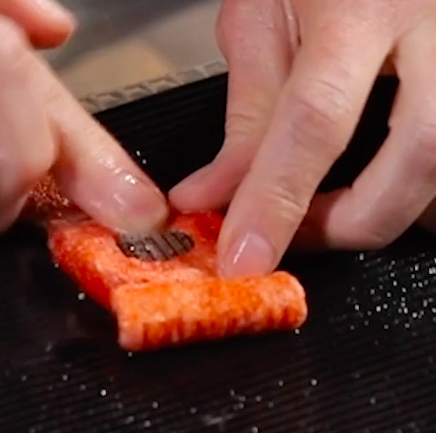
Since beginning to teach my Online & Onpoint! Coursework, I have very much appreciated having my making filmed one time with a broad and detailed camera and therefore cutting back on using my hands for every demo also. The structure and length of my online courses allow participants to learn techniques AND apply them in a design/idea while supported by my mentoring and other participants encouragement. I love it and am excitedly working on the content of the next 10 week course for release in the spring of 2023. Images below are from Course 1, Foundational Structure.
That’s not to say I won’t be out and about in the world offering Face to Face Workshops, in fact, I am reserving my energies for just that…going all out when I choose to travel to teach and when I have a strong idea to make. You can check the TEACHING SCHEDULE at www.strongfelt.com for both Online Courses and F2F Workshops. I’ll be in the Pacific NW, Belgium and Switzerland late summer/early fall of 2023.

Felt the need to post about gratitude for my hands today in all their kinky glory.
Posted on

Blue Reach

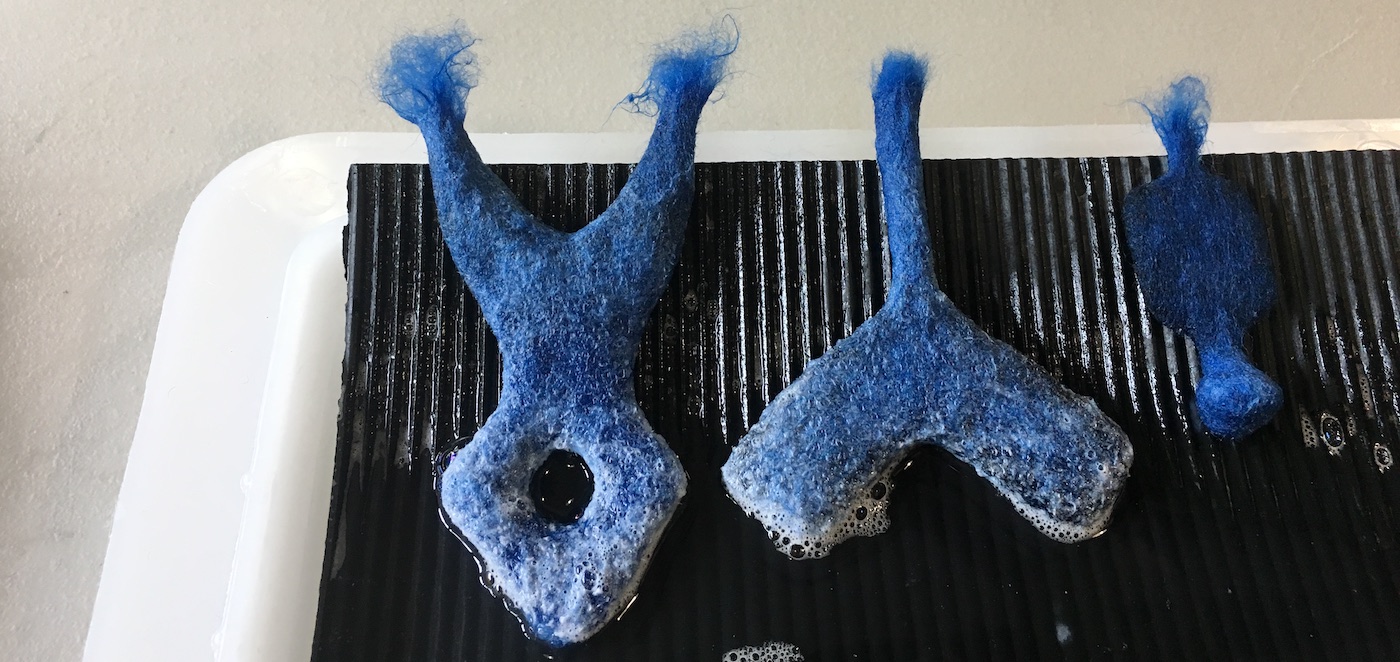
Three blue felted shapes drying on tray

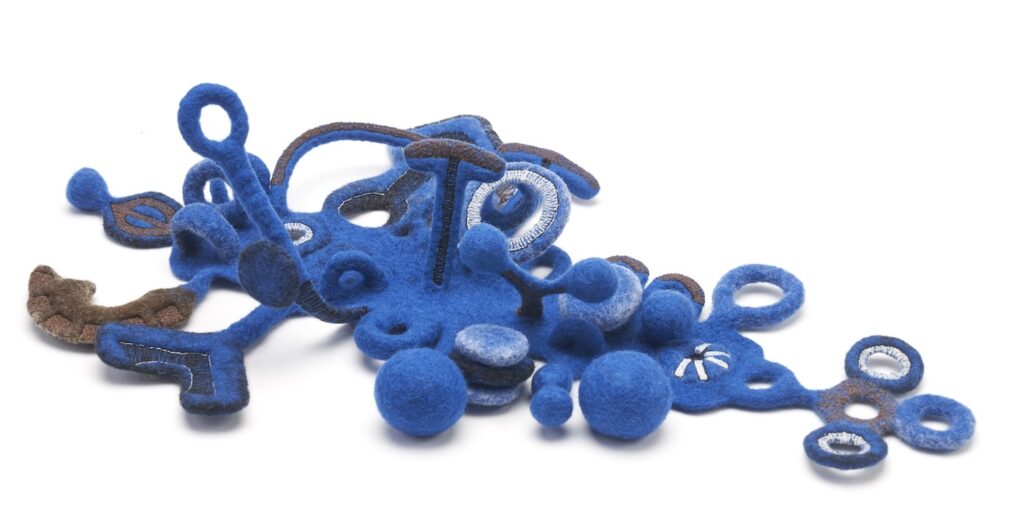
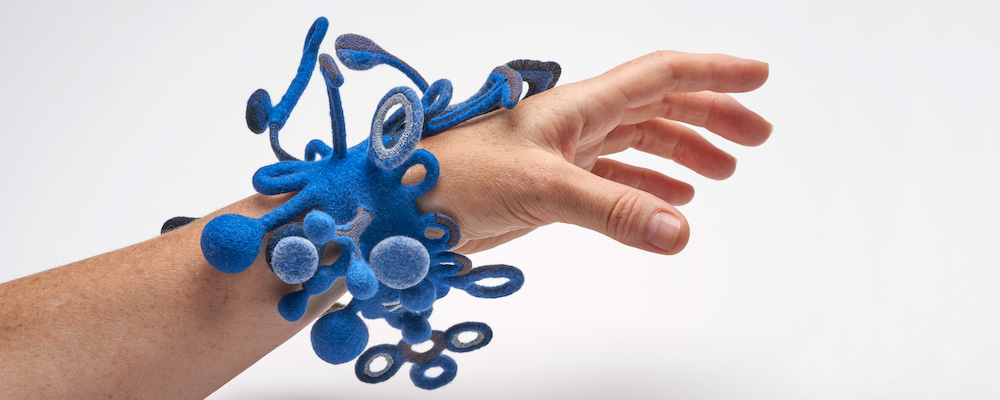
I finally remembered to bring this grasping/clasping cuff to a photo shoot with Steve Mann of Black Box Photography to document it properly. It’s only been about 5 years since I made it! Blue Reach now has a featured spot on my website under the Adorned WORKS Gallery, BRACELETS and can be viewed in the rotation of images on the HOME page.

Blue felted bracelet with loops and spheres

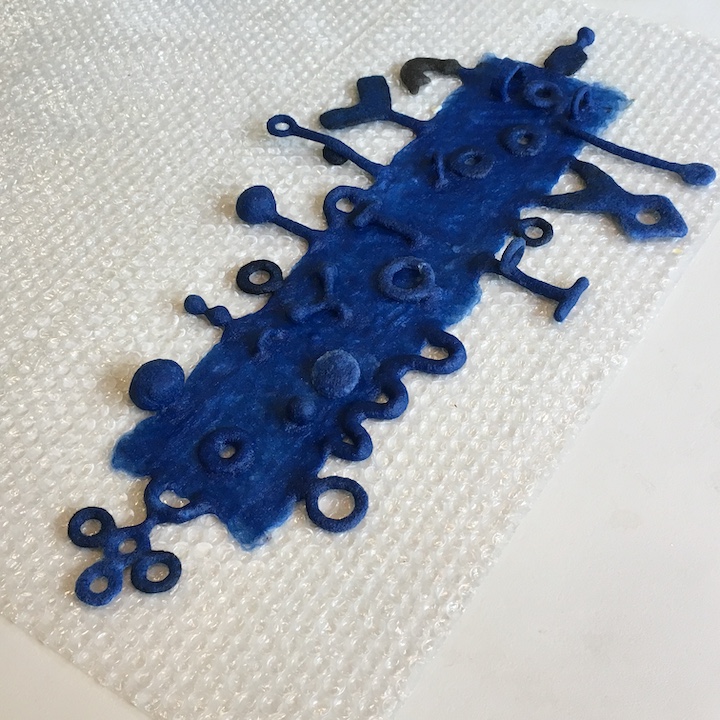
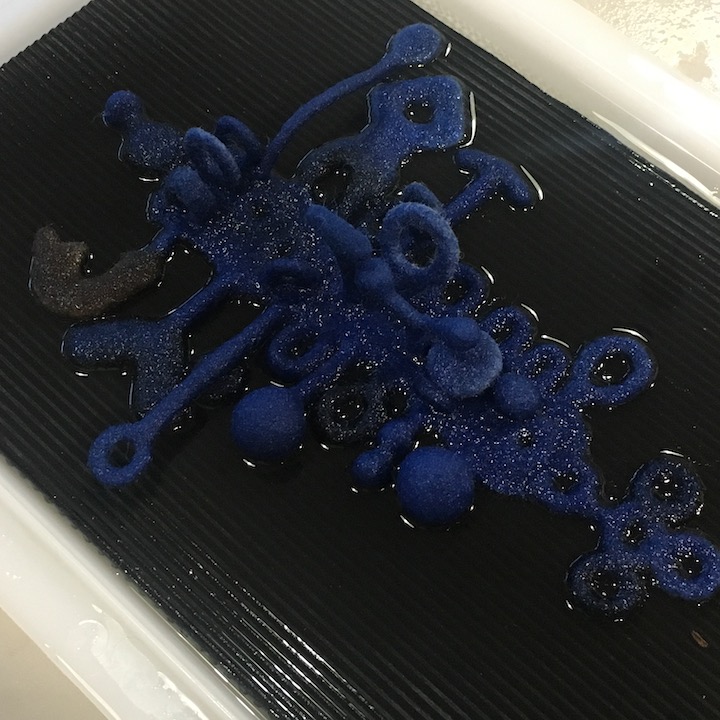
While preparing samples for one of the two courses I had offered at Maiwa School of Textiles in the fall of 2017, Felt Secure: Solid Form Felting Techniques for Clasps & Closures, I had the wild idea of taking all my class samples and attaching them to one plane to make a cuff. It has proven to be a good means to keep all those components in one place, but also to address the need for connection, particularly when one is feeling blue. There are both outward protuberating clasp components, as well as receiving holes, hoops, bridges and tunnels.

Blue abstract felted wool on paper towel
Blue textured abstract shapes on black ribbed surface

It’s timely to have gotten these pics and to share them in this post on my website’s blog, INTRIGUE, as I am working on the content development of Course 2 in my Online & Onpoint! Felt Jewelry Series: Material, Technique & Impact this Fall of 2022. Course 2 will focus on the use of Partial Felt in solid form, 2D plane and hollow form wet felting and will be made in a range of initial layout weights/area and felted to different states of integrity (% of shrinkage) of what is possible for that weight/area. One such application will be using Partial Felt as a core as related to how participants of Course 1 developed solid forms. I got soooo excited about stepping the learning up from the Foundational Structure studies of Course 1 while revisiting each of these clasping components for a little shaving and snipping of stray hairs before the photos.

Posted on

Intertwining Lives & Lines

Felted wool branch with knotted tendrils

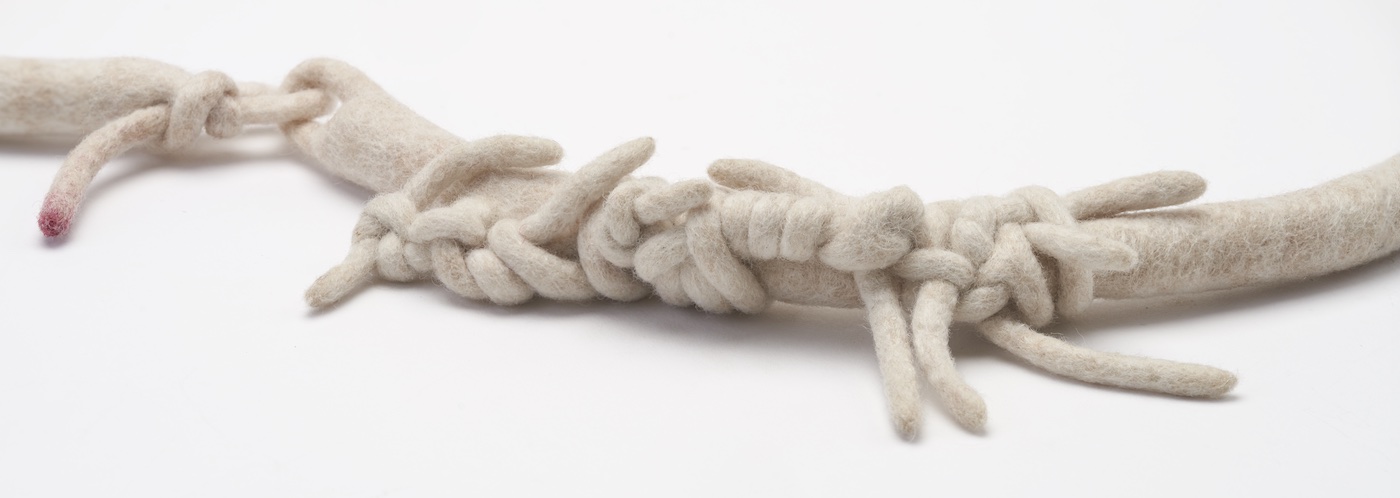
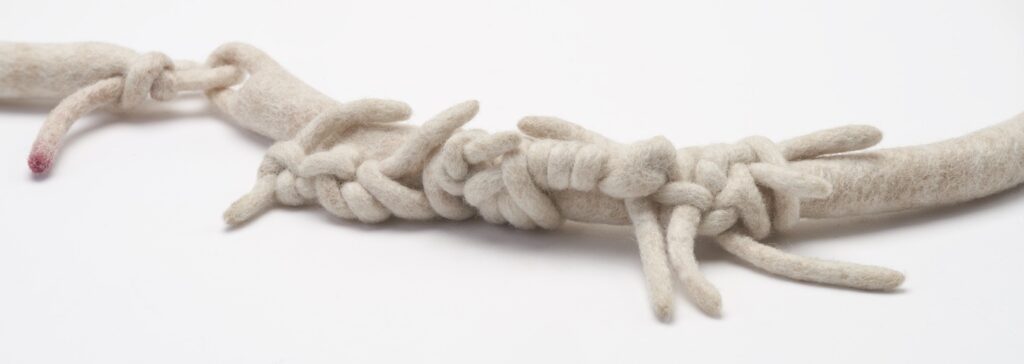
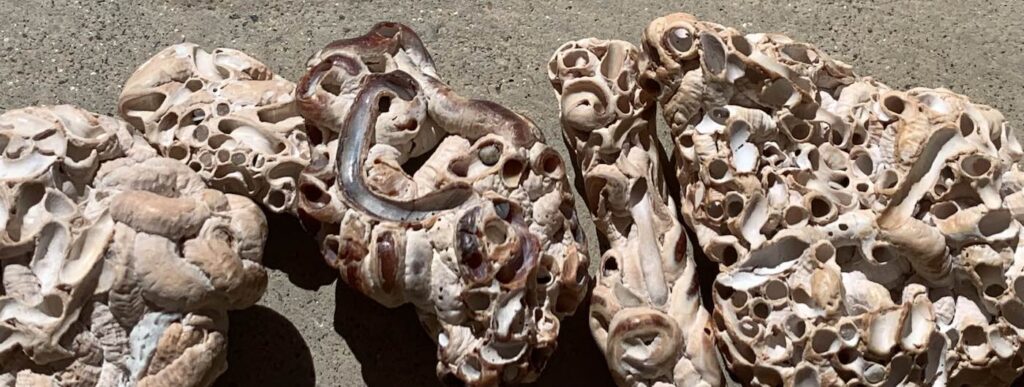
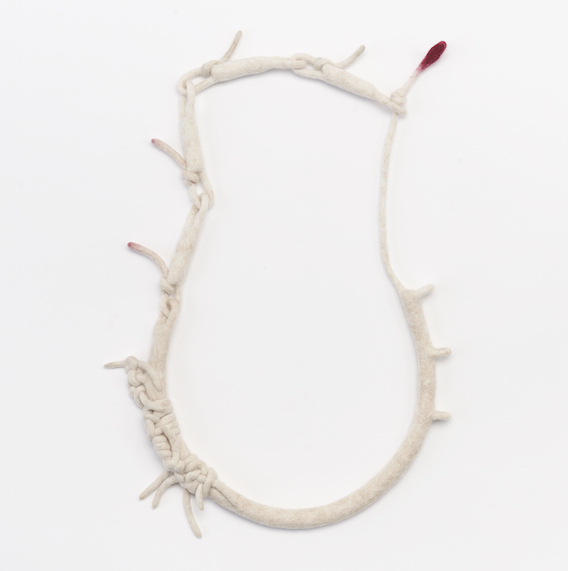
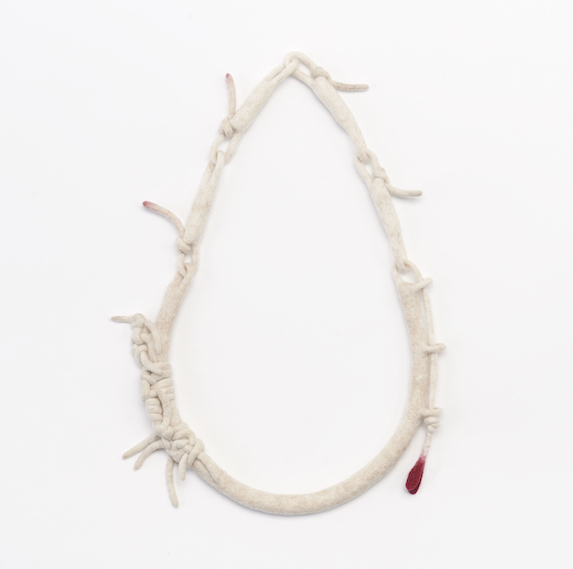
I’ve been working in the studio on additional adjustable clasping necklaces in my Mechanoreception Series that I started this past July 2022. I began conceiving of this work, however, when I came across masses of worm tubes on Florida’s gulf coast beaches in December of 2021… my first excursion during the isolating COVID restrictions. Not familiar with the word mechanoreception? It’s an animals reaction to external stimuli such as touch, pressure, vibrations and sound or rather its ability to react to such. I’m a little preoccupied by the anthropomorphic behaviors of the Annelid class of tube building worms as related to their dwelling in dense masses, yet each in an isolated silo as well as their quick recoil to external stimuli. The meshwork of their tubes is also a fantastic representation of the intertwinement of wool filaments in felt that is otherwise hardly visible with the human eye.

Porous honeycomb coral rocks on concrete
White knotted necklace with red-tipped ends
Mechanoreception 3, extended vs closed
White knotted rope necklace with red accent

The choice of an adjustable clasp that opens up the neckpiece to a larger circumference and also closes it down is informed by the operculum of the Serpulidae family of Polychaeta tube worms, a little door that blocks the entrance to their silo when they retract. 

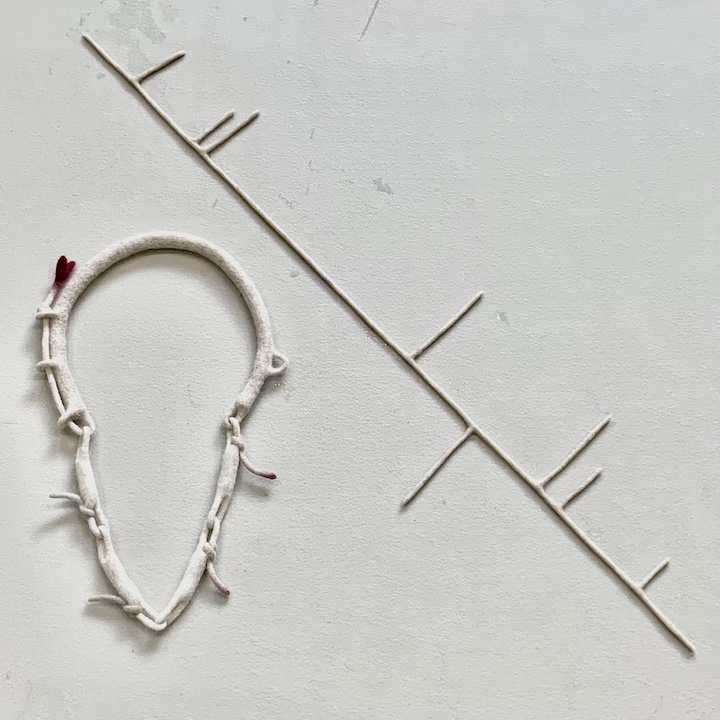
I was paying particular attention to the extended state of the cords before introducing my external force to act out their knotting and recoiling. It reminded me of a country road with quite some space between where smaller roads intersect, like out by my maternal grandparents farm in Avoca, Michigan or the roads that rambled off from highway 522 north of Taos, New Mexico where I lived in the late 90’s. I associate the dominance of space between lines in real time or when viewing a map with sparse populations and calm. Some people feel vulnerable in open space, but it is there that I feel possibility, the possibility of movement.

Minimalist branch-like wall sculptures with red tips

It is no wonder that I have a fondness for laying my filaments of wool ridiculously thin to felt a 2D plane, like the country roads on a map. It is the space between those filaments that allows for the extraordinary movement and intertwinement that results in high shrinkage, strong, yet still flexible felt. I’ve always preferred living in the small towns between those spacious lines on a map and travelling inward to the denser population grids upon occasion. I’ve always felt a bit sensory sensitive, more of a country mouse if you will.